

WAEC past questions and answers
Over 13,000 WAEC (WASSCE) objective past questions in 23 subjects, from 1988–2024, each with the answer and an explanation. The newest papers we hold are from 2024. Practise them on a timed CBT screen in the Skolra app.
Ten questions with answers on this page · All of them in the app, with some free every day

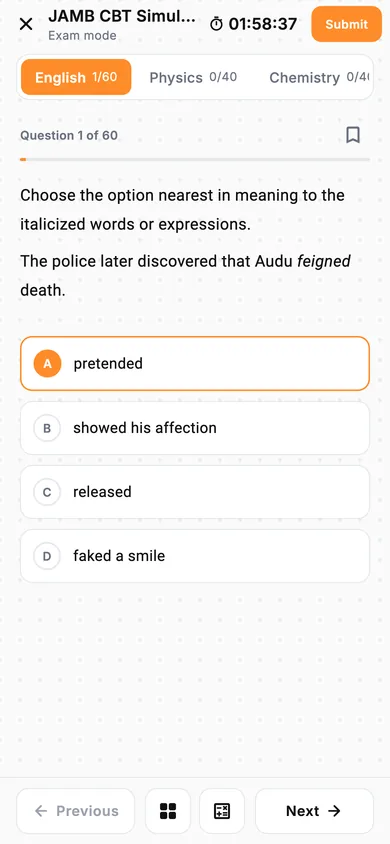
Try ten WAEC past questions
Below are ten of them, one from each of ten subjects. Tap "Show answer" to check yourself and read why.
-
From the 2024 WAEC English Language paper
1.From the words lettered A-D, choose the word that best completes each of the following sentences.
Since all items on the agenda had been discussed, the meeting was _______.
- AadjournedCorrect
- Bcancelled
- Cpostponed
- Dsuspended
Show answerHide answer
Answer: A
The sentence tells us all items on the agenda had already been discussed — meaning the meeting's business was fully completed. The correct word for a meeting formally ending once its business is finished is adjourned.
- A
-
From the 2022 WAEC Mathematics paper
2.Evaluate 23 x 54 (mod 7)
- A1
- B4
- C2
- D3Correct
Show answerHide answer
Answer: D
Find 23 mod 7: 23 = 3×7 + 2, so 23 ≡ 2 (mod 7). Find 54 mod 7: 54 = 7×7 + 5, so 54 ≡ 5 (mod 7). Calculate: 23 × 54 ≡ 2 × 5 ≡ 10 ≡ 3 (mod 7), since 10 = 7 + 3. The product equals 3 when expressed as remainder after division by 7. - A
-
From the 2019 WAEC Physics paper
3.Which of the following properties is not exhibited by sound waves?
- Areflection
- Brefraction
- Cdiffraction
- DpolarizationCorrect
Show answerHide answer
Answer: D
Sound waves are longitudinal waves — particles oscillate parallel to the direction of wave travel. Polarization is a property unique to transverse waves, where oscillations can be restricted to a single plane perpendicular to propagation (e.g., light through a polaroid filter).
Since sound waves have no transverse component, they cannot be polarized. Reflection, refraction, and diffraction are all properties that sound does exhibit.
- A
-
From the 2024 WAEC Chemistry paper
4.An atom of an element in the ground state contains 8 valence electrons. The element is considered as a
- AMetal
- BTransition metal
- CLanthanide
- DNon-metalCorrect
Show answerHide answer
Answer: D
Elements with 8 valence electrons are non-metals like oxygen, sulfur, or halogens. - A
-
From the 2009 WAEC Biology paper
5.GROUP I
SPECIMEN A: Water Lettuce
SPECIMEN B: Cactus Plant
SPECIMEN C: Amaranthus spp / Talinum sppGROUP III
SPECIMEN H: Lungs of mammal
SPECIMEN J: Toad/Frog
SPECIMEN K: Maize leafStudy specimens A, B and C carefully and use them to answer questions (a) to (d).
(a) State the habitats specimens A, B and C.
(b) State (i) two observable features each of specimens A, B and C.
(ii) how the features in 1(b)(i) adapt the specimens to their habitats.
(c) State three Observable differences between specimens A and C.
(d) Make a drawing 8 - 10cm long of specimen C and label fully.
- AReduced leaves and spines to minimise water loss in arid environments
- BDeep extensive root systems that anchor it in dry sandy soils
- CThick waxy cuticles and water-storage tissues for drought resistance
- DAir-filled spongy tissues and floating leaves that keep it buoyant on water surfacesCorrect
Show answerHide answer
Answer: D
Water Lettuce (Pistia stratiotes) is a hydrophyte that floats on the surface of freshwater bodies. Its leaves contain aerenchyma (air-filled spongy parenchyma tissue) that provides buoyancy, keeping the plant afloat. The spongy leaf surfaces trap air and the roots hang freely in water, absorbing nutrients directly. These features are specific adaptations to an aquatic habitat.
- A
-
From the 1998 WAEC Government paper
6.The veto power in the United Nations Organization (UNO) is exercised by- Aall member states in turn
- Bthe Secretary-General
- Cthe five permanent members of the Security CouncilCorrect
- Dthe General Assembly by a two-thirds majority
Show answerHide answer
Answer: C
The five permanent members of the Security Council — the USA, Russia, China, the United Kingdom and France — each hold the right to veto any substantive resolution, making their agreement essential for collective security decisions.
- A
-
From the 2022 WAEC Literature in English paper
7.A story with elements that have both literal and figurative meanings is
- AA parable
- BAn allegoryCorrect
- CA fable
- DA myth
Show answerHide answer
Answer: B
An allegory is a narrative that functions simultaneously on a literal level as a straightforward story and on a figurative level where characters, events, or settings represent abstract ideas, moral qualities, or historical situations.
- A
-
From the 2024 WAEC Economics paper
8.A major feature of the socialist economic system is
- AReliance on free market forces to fix prices and output
- BPrivate ownership of land, labour and capital
- CProduction carried out mainly to maximise profit
- DCollective (state) ownership of the means of productionCorrect
Show answerHide answer
Answer: D
Collective (state) ownership of the means of production is the defining feature of the socialist economic system. Under socialism, land, factories, and other major resources are owned and controlled by the state (or the community) on behalf of everyone, and economic decisions are largely planned by the government rather than left to individuals.
- A
-
From the 2017 WAEC Civic Education paper
9.The following can be classified as forms of political apathy except- AStaying away from political rallies and party meetings
- BRefusal to register as a voter during voter registration exercises
- CLack of interest in discussing government policies and public affairs
- DActive campaigning and canvassing for votes on behalf of a political partyCorrect
Show answerHide answer
Answer: D
Political apathy means indifference or lack of interest in political activities — a citizen simply does not care enough to get involved in the process of government.
- A
-
From the 2022 WAEC Christian Religious Studies paper
10.My soul is very sorrowful, even to death; remain here and watch with me. Where was this remark made by Jesus?
- AGarden of GethsemaneCorrect
- BGolgotha
- CThe Mount of Transfiguration
- DThe Upper Room
Show answerHide answer
Answer: A
Jesus spoke these words in the Garden of Gethsemane on the night of his arrest, as recorded in Matthew 26:38, when he asked Peter, James, and John to keep watch with him while he prayed.
- A
The questions come from past JAMB, WAEC and NECO papers. We use software to help write the answer options and explanations, and every answer is checked twice before it goes on the site. How we check
Spotted a wrong answer? Tell us from the app or on the contact page and we check it.
WAEC questions and answers by subject
Each subject has a page with ten questions and answers, and each paper has its own page with ten more.
- English Language 146
- Mathematics 619
- Physics 1,662
- Chemistry 490
- Biology 1,517
- Government 1,336
- Economics 458
- Literature in English 185
- Christian Religious Studies 420
- Islamic Studies 187
- Commerce 1,038
- Financial Accounting 284
- Geography 260
- Agricultural Science 1,440
- Further Mathematics 843
- Civic Education 491
- Animal Husbandry 244
- Catering Craft Practice 343
- Computer Studies 299
- Data Processing 365
- Insurance 143
- Marketing 318
- Office Practice 144
Papers by year, subject by subject
| Subject | Papers with questions on this site |
|---|---|
| English Language 146 questions | |
| Mathematics 619 questions | |
| Physics 1,662 questions | |
| Chemistry 490 questions | |
| Biology 1,517 questions | |
| Government 1,336 questions | |
| Economics 458 questions | |
| Literature in English 185 questions | |
| Christian Religious Studies 420 questions | |
| Islamic Studies 187 questions | |
| Commerce 1,038 questions | |
| Financial Accounting 284 questions | |
| Geography 260 questions | |
| Agricultural Science 1,440 questions | |
| Further Mathematics 843 questions | |
| Civic Education 491 questions | |
| Animal Husbandry 244 questions | |
| Catering Craft Practice 343 questions | |
| Computer Studies 299 questions | |
| Data Processing 365 questions | |
| Insurance 143 questions | |
| Marketing 318 questions | |
| Office Practice 144 questions |
WAEC past questions by year
English Language and General Mathematics are compulsory for every candidate. These are the subjects each group usually takes with them.
WAEC past questions for science students
WAEC past questions for arts students
WAEC past questions for commercial students
Objective and theory
Each WAEC subject is written as two or three papers. Paper 1 is objective (multiple choice) and Paper 2 is essay or theory. Many science subjects also have a practical paper.
The questions on this site and in the app are objective questions, each with the answer and an explanation.
For WAEC GCE candidates
WAEC GCE is the WASSCE for private candidates. It is set from the same syllabus as the school exam, so these past questions are good practice for it too.
NECO past questions
NECO past questions have their own page, with 8 subjects from the papers of 2000–2009.
Looking for a WAEC past questions PDF?
A PDF only gives you the questions. It cannot time you, mark your answers or tell you why an answer is right.
In the app you answer each question, see at once if you are right, and read the explanation.
WAEC questions and answers for 2027
WAEC does not release the 2027 questions before the exam, and anyone who says they have them is lying. Past papers are the way to prepare: they show you the kind of questions WAEC sets on each topic. Start with the newest, the 2024 papers.
WAEC is moving to computer-based tests
In 2026, WAEC started the computer-based WASSCE (CB-WASSCE) for school candidates in selected centres. Other centres still wrote on paper.
If your school writes on computers, practise on a screen before the exam. In the app, WAEC and NECO questions run on a timed CBT screen, so the screen will not be new to you on exam day.
Check with your school which centres write on computers. How we check these figures
WAEC guides
- WAEC GCE 2027The two series, registration, the computer exam and results.
- WAEC CBT (CB-WASSCE)What changes when you write WAEC on computer, and how to practise.
- WAEC timetable 2027The proposed 2027 dates, the 2026 dates, and how to read the timetable.
- WAEC and NECO CBT practiceTimed WAEC and NECO past questions with answers, in the app.
- NECO past questions and answersQuestions from the NECO papers of 2000–2009, in 8 subjects.
- NECO GCE 2026The exam dates, the 16 subjects, the fee and how to register.
- NECO timetable 2027The proposed 2027 dates, the 2026 dates, and how to read the timetable.
- JAMB past questions and answersOver 9,000 questions in 25 UTME subjects, each with an explanation.